Add to Cart, Immediately Regret, Return With Attitude: The New American Shopping Cycle

At some point in the last few years, buying clothes stopped being primarily about needing clothes. This is not a new observation — retail therapy has been a recognized concept since at least the 1980s — but the scale, speed, and emotional intensity of the current moment is something genuinely different. Americans are shopping impulsively, returning aggressively, and then shopping again, often within the same 48-hour emotional arc, in a cycle that says less about fashion and considerably more about the state of collective mental health in a country that has been through a lot.
The fashion industry is watching this with a mixture of concern and quiet delight, because the numbers are extraordinary.
The Return Economy Is Its Own Economy
According to data from the National Retail Federation, Americans returned approximately $743 billion worth of merchandise in 2023 — a figure so large it requires a moment to sit with. Returns as a percentage of total sales have been climbing steadily since the pandemic reshuffled shopping habits, with online purchases returning at roughly double the rate of in-store purchases. Apparel is consistently among the highest-return categories.
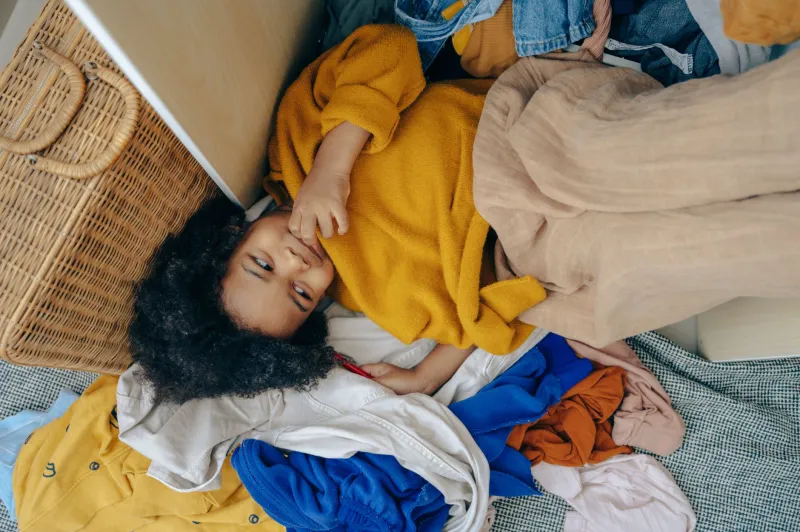
What this looks like in practice is a shopping behavior that functions less like a transaction and more like a rental agreement with extra steps. You order the dress. You try the dress on in your bedroom. You photograph the dress. You decide the dress is not the dress you needed it to be. You print the return label with a sense of righteous efficiency and feel, briefly, like you've won something.
Then you open the app again.
What Are We Actually Buying?
Spend enough time talking to people about their online shopping habits and a pattern emerges that has very little to do with needing a new outfit. The purchases, when examined honestly, tend to cluster around a handful of emotional states that have nothing to do with a closet gap.
The spite purchase: You had a bad week. A bad meeting. A bad date. Something happened and the rational response — journaling, a walk, calling a friend — felt like too much work. The irrational response — adding four items to your cart and checking out before your brain could intervene — felt immediately actionable. "I bought a $200 pair of jeans after my performance review," said one reader who asked to remain anonymous, presumably because her manager reads this site. "I don't know who I was buying them for. Myself, I guess. To prove a point."
The identity purchase: Social media has made aesthetic identity a near-constant project of self-definition, and clothes are the most immediate tool available. You spend forty minutes going down a TikTok rabbit hole about "tomato girl summer" or "dark academia" or whatever the current aesthetic is, and you emerge on the other side with a newly clarified sense of who you are — or rather, who you could be, if only you had the right cardigan. The purchase is not really about the cardigan. It's about the version of yourself the cardigan represents.
The boredom purchase: The simplest and possibly most common driver. You are lying on your couch. The television is on but you're not watching it. Your phone is in your hand. The algorithm, which knows you better than you know yourself, surfaces something. You buy it. You don't remember doing it until the confirmation email arrives.
The optimism purchase: This one is perhaps the most poignant. You buy something for a version of your life that doesn't quite exist yet — the dinner parties you'll host, the trip you'll take, the relationship you'll be in, the job you'll get. The purchase is an act of faith. The return, three weeks later, is the moment faith collides with a Tuesday.
The Algorithm's Role in All of This
It would be convenient to frame this as a personal failing — a discipline problem, a spending problem, a you problem. But the architecture of modern online retail has been deliberately engineered to bypass rational decision-making at every available opportunity.
The infinite scroll removes natural stopping points. The "only 3 left!" badge creates urgency that doesn't exist. The one-click checkout eliminates the friction that might otherwise give you a moment to reconsider. Retargeting ads follow you across the internet like a patient, well-dressed ghost, showing you the item you looked at for thirty seconds three days ago until you capitulate.
And then there's the social media layer. The TikTok Shop integration, the Instagram product tags, the haul video that makes a pile of fast fashion look like a treasure hunt — these are not accidental features of a neutral platform. They are a conversion funnel disguised as entertainment, and they are extremely good at their job.
"I watched a fifteen-second video of someone pulling things out of a bag and I spent $140," said another reader, with the tone of someone confessing something at a support group. "I don't even remember what I bought. I just remember feeling excited."
The Return as Emotional Closure
What makes the return interesting — psychologically, culturally — is that it's rarely just logistical. The return is often the moment the emotional transaction gets completed. You bought the thing in a state of excitement or distress or hope. You return it in a state of clarity, or resignation, or mild embarrassment. The return label is the punctuation at the end of a feeling.
This is why the "revenge return" has become its own cultural phenomenon — the purchase made in anger, returned in triumph, with the satisfaction of having briefly inconvenienced a corporation that did not notice or care. It is an act of self-expression with a free shipping label.
Retailers have started to push back, adding return fees, shortening windows, and using AI to flag "serial returners" — a term that sounds like it belongs in a true crime podcast but refers to people who return more than a statistically expected percentage of their purchases. Which is to say: people who are doing exactly what the one-click checkout and the free returns policy invited them to do.
What Would Honest Shopping Actually Look Like?
Nobody is suggesting you stop buying clothes. This is a fashion website and we have a vested interest in the continued existence of fashion. But there's a version of shopping that starts from an honest question — what am I actually looking for right now, and is a ribbed tank top going to provide it? — that tends to result in fewer returns, fewer regrets, and fewer confirmation emails that arrive like a surprise from a past self you barely recognize.
The emotional impulse behind the purchase is not the problem. The impulse is human and valid and often quite understandable. The problem is when the cart gets treated as a feelings management system, because it is a genuinely ineffective one — and the algorithm running it is not on your side.
Buy the thing or don't buy the thing. But at least know why you're buying it.
And maybe keep the return window open. Just in case.