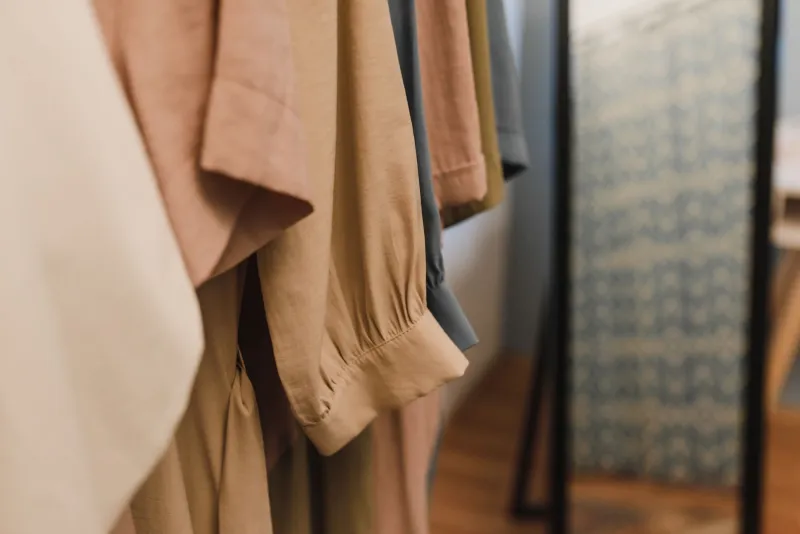
Sage Green Is the New Olive and You've Already Bought This Shirt Before
Somewhere between unpacking your latest haul and hanging it in your closet, you may have experienced a faint, unsettling feeling — a kind of retail déjà vu, like your wardrobe just winked at you. That oversized button-down. The slightly tapered trouser. The 'transitional' midi skirt with the subtle texture. You've been here before. You've owned this before. You just didn't recognize it because this time it's described as "dusty sage" and retails for $12 more.
Welcome to the closet rotation scam — fashion's most successful long con.
The Color Rename Is Doing All the Heavy Lifting
Let's start with the most audacious tool in the seasonal reinvention playbook: the color rebrand. Olive becomes sage. Sage becomes moss. Moss becomes "forest morning." Rust becomes terracotta. Terracotta becomes "clay." Clay becomes "earth spice," which is just rust again but now it's $68 and available only through a limited drop.
Fast fashion brands have quietly mastered the art of recycling the same silhouettes across multiple seasons by doing little more than shifting the Pantone reference and updating the product copy. The boxy linen top that was "summer casual" in June? It's now a "layering essential" in a deeper hue, styled with a scarf in October, and nobody is supposed to notice.
Spoiler: we notice. We just keep buying it anyway.
The Forensic Breakdown Nobody Asked For (But Everybody Needed)
To understand how deep this goes, consider the lifecycle of a single garment concept — say, the relaxed wide-leg pant — at a mid-tier retailer. Spring collection: wide-leg linen trousers in cream, described as "effortlessly breezy." Fall collection: wide-leg twill trousers in camel, described as "elevated staples." Winter collection: wide-leg pants in charcoal, now mysteriously called "the foundational pant," as though the pant has achieved enlightenment.
Same pattern. Same inseam. Different emotional marketing. The retailer has effectively sold you the same pant three times across twelve months, and you felt great about every single purchase.
Brands notorious for this include the usual suspects: fast-fashion giants who operate on micro-season cycles so rapid that "new arrivals" can mean something that launched eight weeks ago in a different colorway. But it's not just the H&Ms of the world. Plenty of mid-range brands with aspirational branding and carefully curated Instagram grids are running the exact same play — just with slower shipping and a slightly higher thread count.
The Psychology of 'New' Is Embarrassingly Simple
Here's the part that stings a little: the reason this works is not because consumers are unintelligent. It's because novelty is a genuinely powerful psychological trigger, and the fashion industry has spent decades engineering environments that exploit it with surgical precision.
Research consistently shows that the anticipation of a new purchase activates dopamine pathways in ways that the actual ownership of the item rarely sustains. The brands know this. The algorithm knows this. The email with the subject line "Just In: Your New Fall Favorites" that arrived in your inbox at 7:43am on a Tuesday knows this with a specificity that should concern you.
The color rename is specifically designed to reset your internal memory of a product. "Dusty sage" doesn't trigger the same recognition as "the olive shirt I already own." It bypasses your rational brain and goes straight to the part of you that genuinely believes this one will be different.
The Repeat Offender Lineup
Without naming every brand on the planet, there are categories of repeat offenders worth identifying by behavior:
The Seasonal Relaunch Artists: These brands pull the same core styles out every year with minor fabric tweaks — a slightly ribbed version, a washed version, a "premium" version — and market each iteration as a collection evolution. You are paying for the word "premium."
The Trend Chameleons: Brands that take a single silhouette and relabel it according to whatever aesthetic is trending on TikTok that month. The same wrap dress becomes cottagecore, then coastal grandmother, then quiet luxury, depending entirely on how the marketing team is feeling.
The 'Limited Edition' Illusionists: Brands that create artificial scarcity around items that are, functionally, always available in some form. The colorway sells out. A new colorway appears. The cycle continues. You feel urgency. They feel profitable.
How to Break the Loop (Or At Least Acknowledge You're In It)
The honest answer is that most of us are not going to stop buying clothes, and that's fine. Fashion is fun. Getting something new is fun. But there's a meaningful difference between buying intentionally and being perpetually outmaneuvered by a product team whose entire job is to make you feel like this season's muted green is categorically different from last season's muted green.
A few genuinely useful reality checks before your next haul:
Take a photo of your closet before you shop. This sounds basic because it is, but confronting your existing inventory in visual form is remarkably effective at revealing how many "gaps" you're filling are not actually gaps.
Read the product description backwards. Strip out the aspirational language and describe the item in the most boring terms possible. "Relaxed-fit earth-toned trouser with an elastic waist." Do you own one of those? You almost certainly own one of those.
Give it the color test. If the color name has more than two words, or contains the word "morning," "dusk," "fog," or any weather phenomenon, assume it is a color you already own.
The closet rotation scam is not going anywhere. But at minimum, you can look at your newest sage green purchase with the full, clear-eyed knowledge that somewhere in the back of your closet, an olive shirt is waiting for you to remember it exists.