Send Pic, Receive Chaos: The Group Chat Outfit Approval System Is Broken and We Have Proof
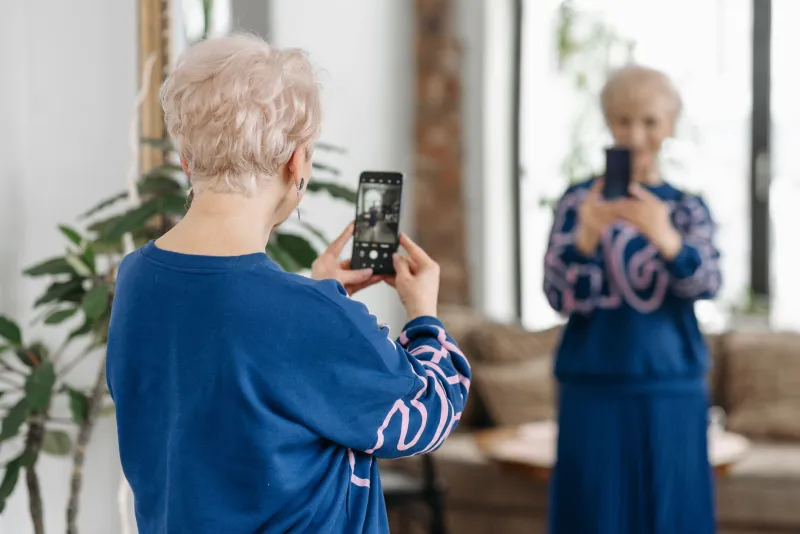
It starts with good intentions. You have an event — a first date, a work dinner, a birthday party for someone whose aesthetic you find slightly intimidating — and you are not sure about the outfit. Reasonable. Normal. Human. So you do what millions of Americans do every single evening: you prop your phone against a stack of books, take a mirror selfie in lighting that is doing its best, and send it to the group chat with a question that is technically a question but is actually a plea.
Is this too much?
Does this work?
Honest opinions only (you do not mean this).
The replies arrive. And somehow, by the time you've read all of them, you are less sure about the outfit than you were before you asked.
Welcome to the Group Chat Outfit Approval Pipeline — fashion's most democratic, most chaotic, and least useful decision-making system currently in operation.
The Photo: A Study in Strategic Ambiguity
Before we get to the responses, we need to talk about the photo itself, because the photo is doing a lot of work and most of it is accidental.
The Group Chat Outfit Photo exists in a specific visual register. It is taken at arm's length or propped against something unstable. The lighting is either too warm (lamp) or too cold (bathroom overhead). You are standing at a slight angle because full-on feels too vulnerable. One shoe is sometimes visible; the other is cropped out. There is, almost always, something in the background — a pile of rejected outfits, a half-open closet, a laundry basket you have been meaning to deal with — that tells a more complete story about the evening than the outfit does.
The image quality is also, statistically, worse than any photo you have ever taken of food. You have photographed a plate of tacos in better resolution than this.
And yet: you send it. Because the group chat does not need a fashion editorial. The group chat needs to feel consulted.
The Cast of Characters Who Will Reply
Every group chat outfit approval thread contains the same recurring characters. They are as follows:
The Enthusiast. Replies within forty-five seconds. 'OBSESSED.' 'You look SO good.' 'Wear it.' This person's response, while emotionally welcome, contains no actionable information. They would say this about anything. You know this. You still needed to hear it.
The Pragmatist. Takes three minutes to reply, which already feels like a bad sign. 'Where are you going again?' They need context before they can commit. This is, honestly, the most reasonable approach, but it slows the whole process down and introduces a new variable: now you have to explain the event in enough detail that the Pragmatist can render a verdict, which takes longer than just deciding yourself.
Melissa. Melissa says 'cute!!' Melissa always says 'cute!!' Melissa has said 'cute!!' to a photo of you in a hospital gown. Melissa's 'cute!!' is not feedback. It is ambient warmth. You love Melissa. Melissa is useless to you right now.
The Alternative Suggester. Did not answer your question. Instead: 'What about the black one?' There is no established context for 'the black one.' You have seventeen black things. The Alternative Suggester has now introduced a new candidate into a race you were trying to close, and the whole process resets.
The Honest Friend. Takes the longest to reply. When they do, it is measured, specific, and slightly alarming. 'I think the proportions are a little off with that shoe — do you have something with less heel?' This is the only genuinely useful feedback in the thread. You will feel briefly defensive about it before realizing they are completely right.
The Non-Responder. Read the message. Did not reply. Has been active on Instagram since. You will think about this for longer than is healthy.
The Feedback Loop That Helps No One
Here is the structural problem with the Group Chat Outfit Approval Pipeline: it was designed for consensus, but fashion is not a consensus activity.
Your friends are not you. They do not know what you're wearing the outfit for, not really — not the specific social dynamics of the room you're walking into, not the precise emotional register you're trying to hit, not the fact that you wore the black one last time and felt invisible. They are working from a blurry photo and whatever mood they happen to be in at 7:47pm on a Thursday.
The result is feedback that is simultaneously too much and not enough. Too many opinions pulling in different directions, not enough of them grounded in the actual context of your life. By the time the thread has run its course, you have received approximately six different verdicts on an outfit you were already seventy percent sure about, and now you are forty percent sure about it, which is worse.
There is also the question of what people say versus what they mean. 'That's so you' can mean 'you look amazing' or 'this is exactly the kind of thing you would wear and I am not sure that's a compliment.' 'Bold choice' means they don't like it. 'I think it depends on the vibe you're going for' means they don't like it and also don't want to say so.
Reading the group chat is its own interpretive art form, and nobody has time for that at 8pm.
The Final Decision: Always Made Alone
Here is the part that makes the whole enterprise philosophically interesting: after all of it — the blurry photo, the contradictory replies, the Melissa 'cute!!', the Alternative Suggester reopening the black dress question — you make the final decision alone.
You do. Every time. At 11pm, standing in front of your mirror with the group chat still open in one hand, you look at yourself and you decide. Not based on the thread. Based on the thing you already knew before you sent the photo.
Because the group chat was never really about the outfit. It was about the anxiety around the outfit — the first-date nerves, the work dinner pressure, the low-grade social fear that you might show up wrong. The photo was a way of externalizing that anxiety, distributing it across six people so it felt less like a solo problem.
Which is, actually, a completely understandable thing to do. It just happens to be dressed up as a fashion question.
So Does Any of This Actually Help?
Occasionally, yes. The Honest Friend's comment about the shoes was correct and you know it. Sometimes a second pair of eyes catches something you genuinely missed — a fit issue, a styling conflict, something that reads differently on camera than it did in your head. The group chat is not without value.
But as a primary decision-making system for personal style? It has some meaningful structural flaws. It is crowd-sourced taste applied to an individual context. It replaces your judgment — which is actually pretty good, because you know yourself — with a committee of people who are trying to be supportive while also watching TV.
The outfit you feel best in is almost always the one you knew you wanted before you asked. The group chat just gives you permission to wear it.
Which is, when you think about it, a lot of infrastructure for something you could have told yourself for free.