The 'I Can Make This Work' Manifesto: A Forensic Autopsy of Every Unconventional Purchase You Absolutely Cannot Make Work
The 'I Can Make This Work' Manifesto: A Forensic Autopsy of Every Unconventional Purchase You Absolutely Cannot Make Work
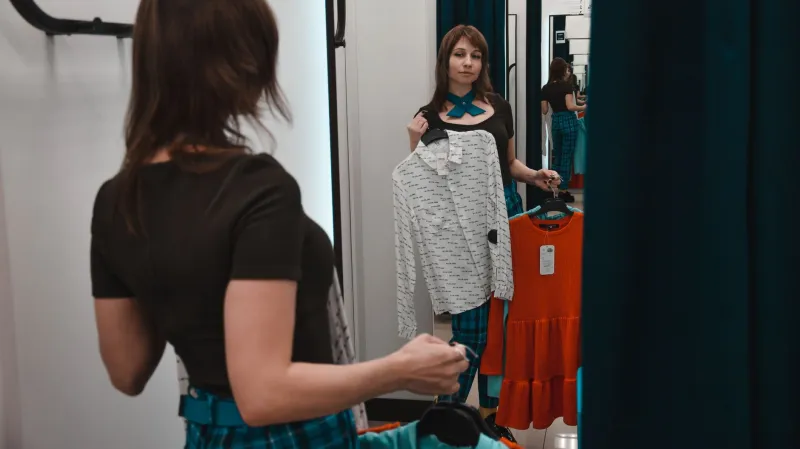
Let's set the scene. You are in a dressing room. The lighting is doing something generous. A song you like is playing faintly through the store speakers. You are holding a garment that is, by any objective measure, shaped like a geometry problem — an asymmetrical hem that dips aggressively to one side, a shoulder situation that implies you are auditioning for a regional production of Cats, trousers that are technically also a skirt depending on how you look at them and, more importantly, how you move.
You try it on. You tilt your head. You say the words.
I can make this work.
And just like that, $178 leaves your account for something that will spend the next fourteen months on a hanger, judging you.
The Anatomy of the Delusion
The 'I can make this work' moment is not random. It follows a very specific psychological sequence that fashion researchers have not studied because they are busy, but we have been paying close attention.
Step one: You encounter the piece. It is unusual. It is doing something structurally ambitious. A normal person would say 'that's interesting' and keep walking. You do not keep walking.
Step two: You try it on, partially to confirm your instinct that it won't suit you, partially because you are already emotionally involved. The mirror shows you something that looks, generously, like a 'statement.' You begin constructing the statement.
Step three: The mental gymnastics begin. I'd wear it with simple pieces to let it breathe. I'd wear it to that thing — you know, that thing — the dinner, the gallery opening, the friend's birthday that is definitely happening at a venue where this is appropriate. The fictional event calendar expands rapidly.
Step four: You start casting yourself in a different life. In this life, you are the kind of person who wears sculptural fashion with the confidence of someone who has a skincare routine and a passport full of stamps. You are effortless. You are directional. You are, briefly, a completely different person.
Step five: You buy it.
The Confidence: Where It Came From
The origins of 'I can make this work' confidence are worth examining forensically, because it does not come from nowhere. It arrives in waves, usually triggered by one of the following:
A recent compliment. Someone told you that you looked amazing in that olive coat three weeks ago, and you have been riding that serotonin ever since. You are currently operating at a style confidence level of about 140%, which is exactly enough to convince you that a trouser-skirt hybrid is a reasonable life choice.
An Instagram rabbit hole. You spent forty-five minutes looking at someone — a model, an influencer, a woman in Copenhagen who appears to have no job but extraordinary bone structure — wearing exactly this kind of piece with apparent ease. You did not account for the fact that she is six feet tall, lit professionally, and has been wearing avant-garde fashion since she was seventeen.
The 'I'm reinventing myself' energy. Something shifted recently. Maybe you got a promotion, ended a relationship, or simply had a really good Tuesday. You are in a transitional moment. You want your wardrobe to reflect the new chapter. The asymmetrical hem is less a garment and more a manifesto.
Store lighting. This one is underrated. Retail lighting is engineered to make you feel like the protagonist of something. It should be illegal.
The Confidence: Where It Went
Here is what happens when you bring the piece home.
The lighting in your apartment is regular lighting. The song is no longer playing. You try the garment on again, this time in front of your actual mirror, in your actual life, with your actual wardrobe around it. You reach for the 'simple pieces' you planned to balance it with. The simple pieces look confused. The garment looks confused. You look like you are wearing a dare.
You hang it up and tell yourself you just need to find the right occasion.
The right occasion does not come. Or, more accurately, occasions come — plenty of them — but each one is slightly wrong for the piece. Too casual. Too formal. Too 'I need to be able to sit down.' The garment develops a reputation in your closet as something that requires a very specific set of circumstances that never quite align. It becomes, essentially, theoretical clothing.
A Taxonomy of Unconventional Purchases and Their Survival Rates
The Extreme Shoulder. Purchased because it looked powerful. Worn once to a work thing where it made everyone slightly uncomfortable. Currently in the back of the closet. Survival rate: one outing.
The Asymmetrical Hem. Purchased because it felt 'unexpected.' You spent forty minutes trying to figure out which shoes work with an uneven hemline and arrived at the answer 'none of your current shoes.' Survival rate: zero outings, four try-ons.
The Trouser That Is Also a Skirt. Purchased because you respected the concept. You do not, it turns out, want to wear a concept. You want to wear pants. Survival rate: wore it once, spent the entire evening explaining it to people.
The Deliberately Oversized Blazer. This one occasionally makes it out. You have styled it three ways, two of which worked. Survival rate: moderate. The exception that proves the rule.
The Sheer Layer Over Nothing Obvious. Purchased because it looked editorial. Discovered at home that 'editorial' requires a specific undergarment situation you do not own. Survival rate: wore it once over a tank top and felt immediately like you'd ruined the vision.
The Part Where We Ask the Hard Questions
Here is the thing about 'I can make this work' energy: it is not entirely delusional. Sometimes people buy unusual pieces and genuinely integrate them into a wardrobe with confidence and creativity. This happens. We have seen it.
But there is a meaningful difference between 'this is challenging and I have the wardrobe infrastructure to support it' and 'this is challenging and I am currently in a dressing room on a Saturday afternoon feeling briefly invincible.'
The first person has already thought about what the piece is going to live next to. They know their proportions, they have a sense of their own style ecosystem, and they are buying the piece because it genuinely fits into something real.
The second person is you, tilting their head in a dressing room, constructing an imaginary life where this trouser-skirt makes complete sense.
Both of you will buy the piece. Only one of you will wear it.
The Honest Conclusion
We are not here to tell you to stop buying unconventional pieces. Genuinely — some of the best things in anyone's wardrobe started as a 'I can make this work' gamble that paid off. Fashion without risk is just a uniform.
But the next time you are in that dressing room, tilting your head at something architecturally ambitious, it might be worth asking one clarifying question: Am I buying this for my actual life, or for the fictional, better-lit version of it?
If the answer is the fictional version, maybe just take a photo of it. The photo is free. The asymmetrical hem is $178 and it will haunt you from a hanger until you donate it to someone who will also not wear it.
The cycle continues. The hanger spins. The dressing room lighting remains flattering and completely untrustworthy.