Vintage Scholar, Actually Just Browsing: The Great Resale App Delusion of Our Generation

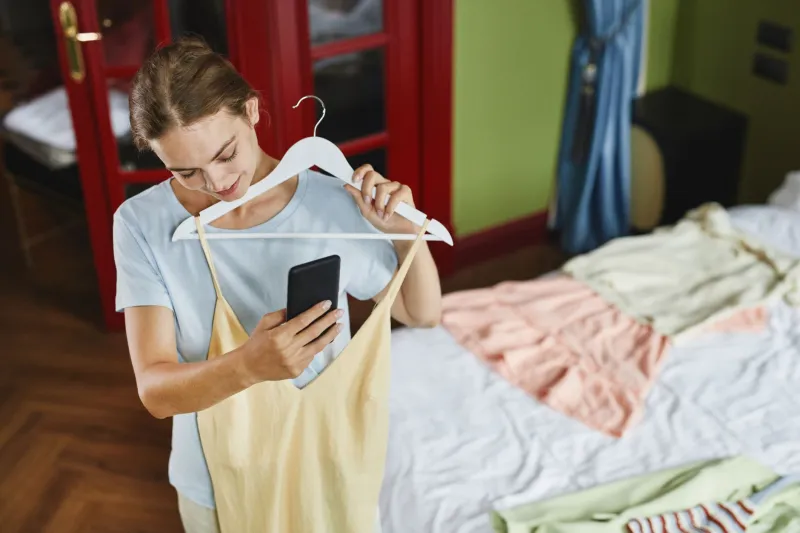
Let's paint a picture. It's a Sunday afternoon. You're scrolling Depop with the focused energy of someone defusing a bomb. You find a "vintage" Y2K denim jacket, listed at $78, described as "super rare, one of a kind, cottagecore meets indie sleaze energy." The seller has 47 five-star reviews and a bio that says "sustainable fashion girlie 🌿." You buy it in under four minutes.
Congratulations. You are now a thrifting expert. You have found a rare piece. You are basically a fashion archaeologist.
You are also, almost certainly, completely wrong about all of this.
The Birth of the Resale Romantic
Depop launched in the US in 2013. Poshmark had already been running since 2011. Vinted crept in more recently. And together, these platforms did something remarkable: they convinced an entire generation that scrolling an app on their phone while watching Netflix was equivalent to spending Saturday mornings elbow-deep in a Goodwill bin in rural Ohio.
The mythology built around resale fashion is genuinely impressive. It has its own vocabulary (deadstock, grail piece, era-accurate, not fast fashion), its own aesthetic (soft-lit flat lays on linen sheets, usually with a candle nearby for no discernible reason), and its own hierarchy of expertise that has approximately zero relationship to actual vintage knowledge.
The resale romantic believes they have a gift — an eye. They can spot the good stuff. They know what's rare. They understand the market. They are, in their own internal narrative, a step above the average consumer, operating in a more meaningful, more sustainable, more intentional fashion ecosystem.
Reader, they are buying the same trends everyone else is buying. They're just paying more for the privilege of calling it vintage.
The 'Rare Find' That Isn't
Here's a thing that is true: if something is listed as "rare" on a resale app, there is a strong statistical chance that it is not rare. The word "rare" on Depop functions the same way "artisanal" functions at a grocery store — it means someone decided to charge more and needed a word to justify it.
The truly rare vintage pieces — the stuff with actual provenance, the deadstock from closed factories, the genuine 1970s Levi's with the original hardware — those exist, but they are not, as a rule, being sold by a 22-year-old in Portland who also has a Spotify playlist called "thrift store babe" and lists her location as "the universe."
What IS everywhere on these platforms is a rotating inventory of relatively recent clothing (think: 2015 to 2019) that has been rebranded as "vintage" through the simple passage of time and the strategic use of the word "Y2K." If it has a logo, a low-rise waist, or any connection to early 2000s pop culture, it is vintage now. The bar has moved. We all agreed to this without a formal vote.
The Markup Mathematics of Self-Delusion
Now let's discuss the selling side of the resale ecosystem, which is where things get genuinely surreal.
At some point, the platforms convinced users that their own closets were basically untapped goldmines — that the Fast Fashion dress they bought for $34 in 2021 was now a collectible, and that the right combination of good lighting and confident pricing could net them $65, easy.
This has led to a generation of amateur resellers who have done the math in a very specific way: they paid $40 for something, they want $75 for it, and they have listed it as "barely worn" when the correct description is "worn twice to things I didn't enjoy and then felt guilty about." The markup is not based on market research. It is based on vibes and the memory of how excited they were when they first bought it.
The resulting negotiation — buyer offers $30, seller counters at $70, both parties feel personally attacked — is one of the defining interpersonal dramas of our generation.
The Sustainability Halo and the Cognitive Gymnastics Required to Maintain It
One of the cleverest things the resale industry did was attach itself to sustainability culture, which gave every purchase a built-in moral justification. You're not shopping. You're rescuing clothing from landfill. You're participating in a circular economy. You are, in some small but meaningful way, saving the planet.
This is a lovely idea. It is also frequently used to justify buying more clothing than you would have otherwise, because each individual purchase feels virtuous. The sustainability math — fewer items, better quality, longer lifespan — quietly stops applying when you've bought eleven "sustainable" pieces in a single month because each one was a great deal.
The cognitive gymnastics required to maintain the sustainability halo while also refreshing your Depop saved searches seventeen times a day are, frankly, Olympic-level. We respect the commitment.
The Algorithm Knows What You Think Is Vintage
Here's the kicker: Depop, Poshmark, and their siblings run on the same algorithmic logic as every other platform. They learn what you engage with, and they serve you more of it. Which means that the "rare finds" appearing in your feed aren't surfacing because you have an exceptional eye — they're surfacing because the app has successfully modeled your taste and is now feeding it back to you on a loop.
You're not discovering hidden gems. You're being shown a curated selection of things that look exactly like things you've already bought, presented in a way that feels like discovery because discovery feels good and good feelings keep you on the app longer.
The vintage scholar and the algorithm are, at this point, in a committed relationship. The scholar just doesn't know it yet.
A Peace Offering
Look — resale apps are genuinely useful. They're a more interesting way to shop than a mall. Sometimes you do find something legitimately good. And the culture around them, delusional as it can be, has nudged fashion discourse toward at least thinking about consumption habits, which is more than cargo shorts ever did.
But maybe — just maybe — we can acknowledge that buying a ribbed tank top from 2018 for $45 on Poshmark is not quite the same as curating a vintage collection. That "thrifting expert" is a title that should probably require more than a Depop account and a confident listing description.
The real rare find, it turns out, is self-awareness.
It's not on any of the apps. We checked.